
Mt Fuji visibility by month
Winter mornings give the best chance, summer afternoons the worst. Here are the figures behind that rule, and what to do with them.
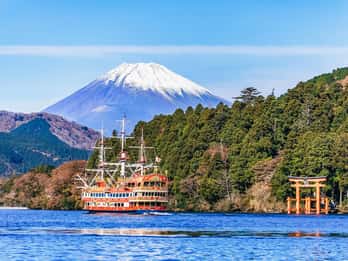
Seeing the mountain is the point of the day, and no tour can promise it. What you can choose is the month, the time of day and the kind of tour. Long-term data from Fuji City shows Fuji on roughly half the days in midwinter and on about one day in twenty in July. Pick the tour to match the season.
Matching the tour to the month
Three kinds of Fuji day, each suited to a different part of the year. Sorted by number of reviews.
| Photo | Tour | Tour type | Months it suits best | Reviews ↕ | Price ↕ | Book |
|---|---|---|---|---|---|---|
|
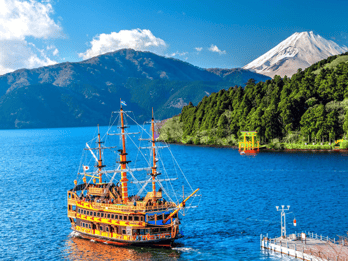
Fuji Tour with Hakone Ropeway and Lake Ashi TAIHOU | Fuji and Hakone by coach | June to September, when Hakone carries a cloudy day | ★ 4.6 (8,254) | €49 per person | Check dates |
|
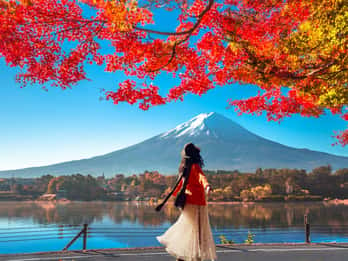
Fuji, Oishi Park, Kawaguchi and Oshino Hakkai JRT Group | Kawaguchiko classic by coach | December to February, when the view is most likely | ★ 4.8 (6,216) | €44 per person | Check dates |
|
|
Fuji and Hakone with Cruise and Bullet Train Japan Panoramic Tours | Fuji and Hakone, Shinkansen back | Late April to November, when the 5th Station road is usually open | ★ 4.4 (5,353) | €136 per person | Check dates |
Fuji tour prices in this table are loaded from GetYourGuide and include taxes and fees. Bus tours are priced per person, private tours per vehicle.
The long-term picture, month by month
The share of days on which Mt Fuji was visible from Fuji City, averaged over about 30 years. Each range spans the first and the second half of the month.
| Month | Fuji seen from Fuji City | 5th Station by road | Also in this month |
|---|---|---|---|
| January | 45–53 % of days | Often closed or skipped | The rest house at the 5th Station is closed until March. Among the clearest weeks of the year. |
| February | 41–44 % of days | Often closed or skipped | Still a good month for the view, and cold at the lakes. |
| March | 28–31 % of days | Often closed or skipped | From here the chance falls month by month until July. |
| April | 25–31 % of days | Usually reopens to tours late in the month | Cherry blossom at the Chureito Pagoda, roughly 10 to 14 days after Tokyo. Golden Week traffic from 29 April 2027. |
| May | 18–25 % of days | Usually visited, weather permitting | Golden Week until 5 May 2027. Moss phlox season around the lakes, dates for 2027 not yet published. |
| June | 6–10 % of days | Usually visited, weather permitting | Rainy season; one of the weakest months for a view. |
| July | 4–6 % of days | Private cars barred from early July | The lowest chance of the year from Fuji City. |
| August | 6–8 % of days | Private cars barred until about 10 September | Obon holiday traffic in mid-August. |
| September | 11–17 % of days | Private-car ban ends around 10 September | Views start to come back late in the month. |
| October | 21–28 % of days | Usually visited, weather permitting | Several times the summer chance. |
| November | 39–44 % of days | Usually visited, weather permitting | Autumn colours around Lake Kawaguchi and clear air. |
| December | 44–56 % of days | Often closed or skipped from about December | Late December and early January bring the best chance of the year. |
Long-term observations from Fuji City, south of the mountain. "Often closed or skipped" refers to the Fuji Subaru Line, which shuts whenever snow or ice is on the road.
Morning or afternoon, north or south
An independent tracker, isfujivisible.com, scores every morning and afternoon from 0 to 10, separately for the north side (Lake Kawaguchi) and the south side. The table shows the share of days in 2026 that scored 8 or more, which the tracker counts as visible.
| Month | North side, morning | North side, afternoon | South side, morning | South side, afternoon |
|---|---|---|---|---|
| January 2026 | 100 % | 100 % | 90 % | 68 % |
| February 2026 | 82 % | 82 % | 68 % | 54 % |
| March 2026 | 77 % | 55 % | 45 % | 16 % |
| April 2026 | 63 % | 60 % | 53 % | 30 % |
| May 2026 | 58 % | 55 % | 48 % | 26 % |
| June 2026 | 27 % | 10 % | 13 % | 3 % |
| July 2026 | 35 % | 13 % | 10 % | 0 % |
| August 2026 | 26 % | 13 % | 13 % | 3 % |
| September 2026 | 13 % | 3 % | 13 % | 3 % |
Percentages calculated by us from the tracker's monthly tables (visible days divided by tracked days). October 2026 had only a few tracked days when we checked, so it is left out.
Why the two sets of figures differ
The long-term values from Fuji City count a day as clear only when the mountain is visible from that one place. The tracker scores the north and south sides separately, twice a day, and counts a score of 8 out of 10 as visible, so a peak showing above a band of cloud can pass. That is why its July figure for north-side mornings is many times the long-term value. Read the long-term column as the cautious estimate and the tracker as what a morning at Lake Kawaguchi looked like in 2026. Both point the same way: winter is far better than summer.
Mornings are clearer
In almost every month the tracker scores the morning higher than the afternoon, and the gap is widest in the warm months. In March 2026 the north side was visible on 77 percent of mornings and 55 percent of afternoons; in July the figures were 35 and 13 percent. Clouds tend to build over the mountain as the day warms up. The coach tours leave Tokyo between 07:30 and 08:30, so in normal traffic the first Fuji stops fall in the late morning, which works in your favour. A tour that goes to Hakone first and to the lakes in the afternoon gives up part of that advantage.
The north side holds its view longer
The Kawaguchiko side, where most of the classic stops are, scored as well or better than the south side in most months of 2026, and in winter afternoons the difference was clear: in January the north side stayed visible every afternoon, the south side on about two thirds of them. The Chureito Pagoda, Oishi Park and Oshino Hakkai are all on the north side.
The Yamanashi Prefecture Tourism Organization runs live cameras pointed at Mt Fuji from Lake Kawaguchi, Fujiyoshida, Lake Yamanaka and other places around the mountain. Combined with the forecast, they show whether the summit has been clearing in the mornings. All tours on this site can be cancelled free of charge up to the deadline on the booking page, so check before that deadline, not on the morning of the tour.
Using the season to choose a tour
From December to February the view is at its most likely and the 5th Station road at its least reliable. A Kawaguchiko tour that stays on the north side all day makes the most of it. From late April to November the 5th Station is usually reachable, and the 5th Station tours come into their own. From June to September the mountain hides most of the time, and a Fuji and Hakone tour still leaves you with the ropeway and Lake Ashi if the summit stays in cloud. In April the cherry blossom draws the crowds while the view is only fair; the Chureito Pagoda page covers that season in detail. What happens to your booking when the day turns out grey is on the weather and cancellation page.
FAQ
What is the best month to see Mt Fuji?
December and January, followed by February and November. Long-term data from Fuji City shows the mountain on roughly 40 to 55 percent of days in midwinter, with the best chance in late December and early January.
What is the worst month to see Mt Fuji?
July, with June and August close behind. Long-term data from Fuji City shows the mountain on only about one day in twenty in July.
Is Mt Fuji easier to see in the morning?
Yes. In almost every month the morning view is more likely than the afternoon view, and the gap is largest in the warm months, when clouds build up during the day.
Can I check whether Mt Fuji is visible today?
Yes. The Yamanashi Prefecture Tourism Organization runs live cameras of the mountain from Lake Kawaguchi, Fujiyoshida, Lake Yamanaka and other places. Look at them together with the forecast before the free-cancellation deadline of your tour.
Do I get a refund if Mt Fuji is not visible?
Do not count on it. GORYO rules it out, Japan Panoramic Tours replaces lost stops instead of refunding, and Zebra Travel does not refund weather changes. No tour on this site promises a refund for cloud; your protection is the free cancellation up to the deadline on the booking page.
Found your month, now find the tour
Route, 5th Station, way back and group size for each Fuji day trip.
See the comparison